Why Your Next EV Should Have Bidirectional Charging (V2H Explained)
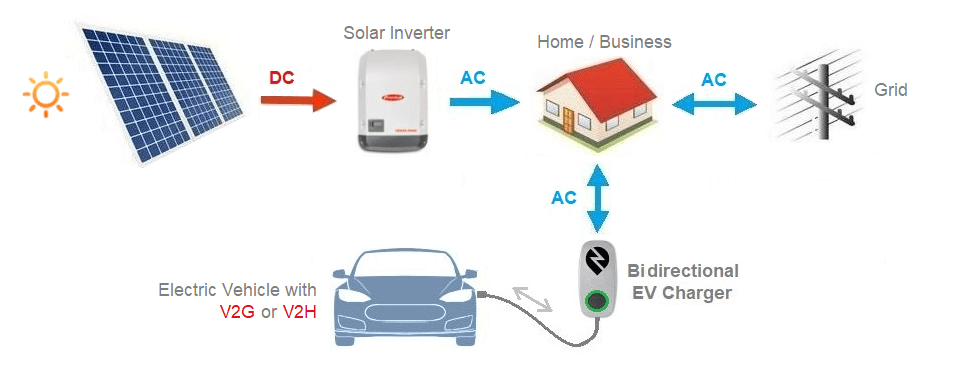
Imagine powering your home during a blackout—using your electric car. This isn’t sci-fi; it’s bidirectional charging, and it’s revolutionizing how we use EVs.
Also called Vehicle-to-Home (V2H), this tech lets your EV store and send electricity back to your house or grid. By 2025, Ford, Hyundai, and Tesla will roll out V2H-capable models—making it a must-have feature for your next EV.
Here’s why V2H is the future, how it works, and what to look for when buying.
1. What Is Bidirectional Charging?
🔌 The Two Key Types
- 1.
Vehicle-to-Home (V2H)
- Powers your house during outages (like a giant Powerwall).
- Example: Ford F-150 Lightning can run a home for 3+ days.
- 2.
Vehicle-to-Grid (V2G)
- Sells excess energy back to the grid (earns you $$$).
- Available in Japan/Europe, coming to the US by 2026.
⚡ How It Works
- EV battery → Inverter → Home/grid
- Requires:
- A bidirectional charger (e.g., Ford’s Charge Station Pro).
- A home energy system (solar panels help maximize savings).
2. Why Bidirectional Charging Is a Game-Changer
✅ Blackout Protection (No More Generators!)
- Example: During a Texas grid failure, a Nissan Leaf kept lights/fridge on for 24 hours.
- EVs vs. Generators:
- Quieter, zero emissions, and no fuel costs.
- Instant response (no 30-sec startup delay).
✅ Slash Your Electricity Bill
- Charge at night (off-peak rates), power home during peak hours.
- Solar combo: Store excess solar in your EV, use it at night.
✅ Future-Proof Your EV
- Upcoming V2G payouts: California’s SB 233 will compensate EV owners for grid support.
- Resale value: V2H-capable EVs will depreciate slower.
3. Which EVs Support Bidirectional Charging? (2025 Models)
| EV Model | V2H? | Max Power Output | Notes |
|---|---|---|---|
| Ford F-150 Lightning | ✅ | 9.6 kW | Powers most homes 3+ days |
| Hyundai Ioniq 5/6 | ✅ | 3.6 kW | Needs Hyundai Home Station |
| Kia EV6 | ✅ | 1.9 kW | Limited to essentials (fridge/lights) |
| Nissan Leaf | ✅ | 2.0 kW | Oldest V2H-capable EV |
| Tesla Cybertruck | ❌ (Coming 2025) | TBD | Elon Musk confirmed future update |
Coming Soon:
- Rivian R1T/R1S (2025)
- Chevy Silverado EV
- VW ID.4 (software update)
4. What You Need for V2H Setup
🔧 Hardware Requirements
- 1.Bidirectional EV (see list above).
- 2.Bidirectional home charger ($2,000-$5,000 installed).
- 3.Transfer switch (safely disconnects from grid during outages).
💰 Costs & Incentives
- Total setup: ~$4,000-$7,000 (before incentives).
- Rebates available:
- US Federal Tax Credit (30% up to $1,000 for chargers).
- California’s SGIP ($500-$1,500 for V2H systems).
5. Real-World Examples: How V2H Saves Money
🏠 Case Study 1: Solar + EV = $0 Bills
- Location: Arizona
- System: Ford F-150 Lightning + 10kW solar panels
- Result:
- Stores excess solar in truck, uses it at night.
- Eliminates $200/month grid dependency.
⚡ Case Study 2: Blackout Protection
- Location: Florida (hurricane-prone)
- System: Nissan Leaf + V2H charger
- Result:
- Ran fridge/fans for 18 hours during outage.
- Saved $800 vs. buying a gas generator.
6. Challenges & Limitations
⚠️ Not All EVs Support It (Yet)
- Tesla’s delay: Still no V2H on Model 3/Y (rumored 2026 update).
- Battery wear? Minimal impact if kept between 20%-80%.
⚠️ Upfront Cost
- Cheaper long-term, but needs $4K+ investment.
⚠️ Grid Compatibility
- Some utilities block V2G (check local rules).
7. The Future: V2G & Smart Grids
🌍 Vehicle-to-Grid (V2G) Will Pay You
- UK trials: EV owners earn $400+/year feeding energy back.
- California’s plan: Rolling out V2G incentives by 2026.
🚗 Your EV = A Rolling Power Plant
- 2030 vision: Millions of EVs stabilizing renewable energy grids.
Conclusion: Bidirectional Charging Is a Must-Have
Why your next EV needs V2H:
✅ Emergency power during outages.
✅ Lower energy bills (especially with solar).
✅ Future earnings from V2G programs.
Action Steps:
- 1.Choose a V2H-capable EV (Ford, Hyundai, Kia).
- 2.Install a bidirectional charger.
- 3.Check local incentives to offset costs.
The future of energy isn’t just clean—it’s mobile. ⚡
Would you use your EV to power your home? Comment below!
(Sources: Ford, CA Energy Commission, Nissan, V2G research papers 2024-2025)
Want more? Subscribe to ColoredCar.com for the latest EV tech deep dives! 🚗💡